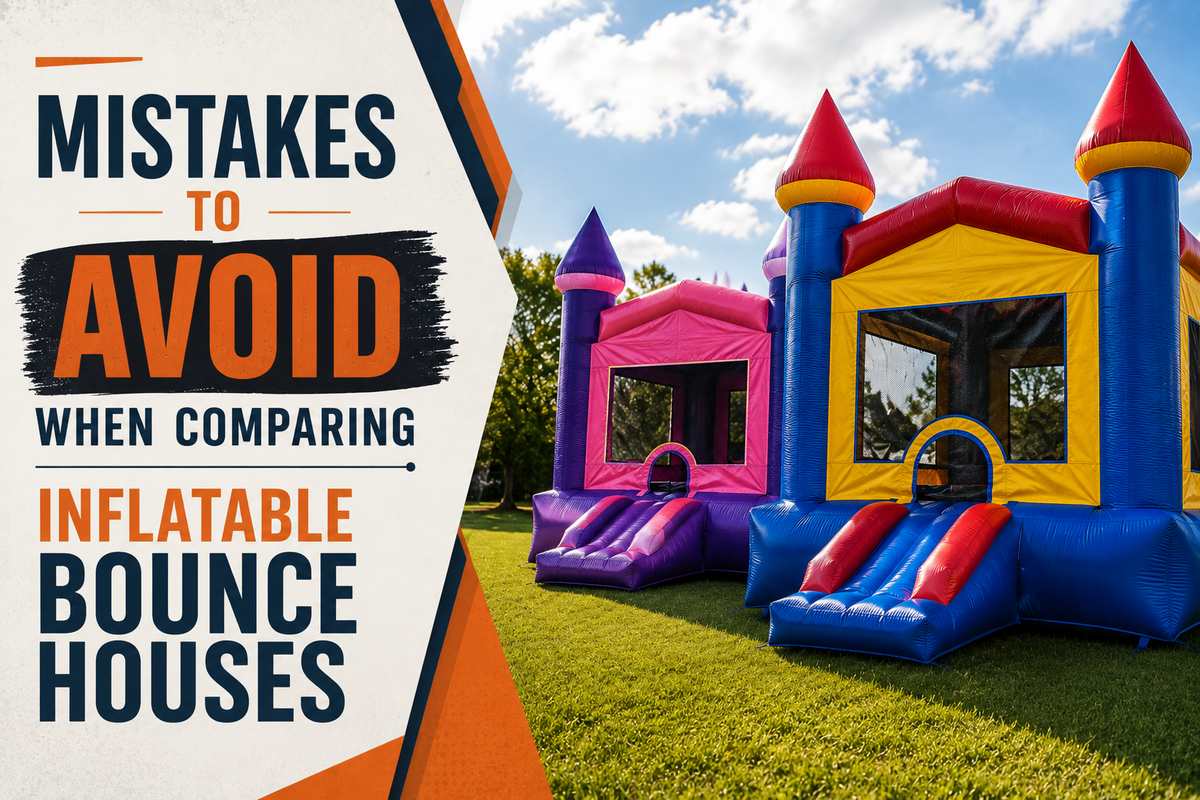
This guide covers the comparison errors that cost buyers the most: skipping the standard a unit was actually built to, accepting certification claims without documentation, glossing over wind and anchoring details, sizing to the unit instead of the site, and leaving freight, blowers, and repairs out of the math. Each section gives you the question to ask a seller and what a straight answer sounds like.
Key takeaways
The most common mistake buyers make when comparing inflatable bounce houses is treating price and dimensions as the whole comparison. A 13 by 13 foot bouncer is a category, not a specification. What separates one 13 by 13 unit from another is the fabric weight, the seam construction, the number of anchor points, the reinforcement at stress areas, the blower it ships with, and the documentation behind it. None of that shows up in a product photo.
The phrase "commercial grade" is a marketing description, not a regulated term. Any seller can print it. What buyers tell us, over and over, is that they only discovered the difference after a seam opened in month three or a rental customer asked for a certificate the seller could not produce. The fix is simple, and it costs nothing: ask every seller on your shortlist for the same written spec sheet, then compare those documents side by side instead of comparing listings. If a seller cannot produce one, you have learned something useful about the product.
The cleanest way to separate a commercial bounce house from a residential one is to ask which ASTM standard it was designed to meet. ASTM F2374 is the standard practice for the design, manufacture, installation, operation, and maintenance of commercial-use inflatable amusement devices. It explicitly excludes inflatable devices marketed to consumers for private home use by children, which are covered instead by ASTM F2729. Those are two different engineering targets, not two grades of the same thing.
F2374 also carries operational requirements that consumer products do not. The standard requires that wind speed limits and other restrictions appear on an information plate permanently affixed to the device, and it requires trained attendants who monitor weather and wind while the device is inflated. When you are comparing inflatable bounce houses, ask which standard applies, then ask to see a photo of the information plate. A seller who claims F2374 for a unit with no plate and no operations manual is describing a product they do not have.
| What you are comparing | Commercial use unit | Home use unit |
| Governing standard | ASTM F2374, commercial inflatable amusement devices | ASTM F2729, home use air inflatable play devices |
| Typical fabric | PVC-coated vinyl over a woven polyester base | Lighter nylon or polyester oxford fabric |
| Information plate | Required by F2374, lists wind limit and restrictions | Not required in the same form |
| Intended duty cycle | Repeated setup and teardown, rental and event use | Occasional backyard use by one family |
| Documentation you should expect | Spec sheet, operations manual, test reports, anchor plan | Consumer instruction sheet |
"PVC vinyl" and "oxford" are material families, not specifications, and comparing bounce houses by material name alone hides most of the difference. Coated vinyl is normally quoted by finished weight per square yard and by the denier of the base fabric underneath the coating. A heavier coating over a heavier base fabric resists punctures and abrasion better than a light coating over a thin weave, even though both can be described in a listing as vinyl.
Seams matter as much as fabric. Ask whether the seams are stitched, double stitched, or heat sealed, and ask what happens at the stress points where the walls meet the floor and where the netting is anchored. In practice, the failure we see first on a hard-working inflatable is rarely the middle of a panel. It is a seam, a D ring patch, or the base of a column. A material answer that stops at the fabric name is an incomplete answer, so push for the construction detail behind it.
Treat every certification claim as unverified until a seller sends you the document behind it. "Meets ASTM" is a statement a company makes about itself. A test report from an accredited third-party laboratory is evidence. The same distinction applies to flame resistance, where public venues and indoor operators frequently require documentation against NFPA 701, and to chemical content, where the Consumer Product Safety Improvement Act sets a total lead limit for children’s products at 100 parts per million.
This is not a theoretical concern in this category. In 2010, the Center for Environmental Health and the California Attorney General sued manufacturers, distributors, and suppliers of bounce houses after testing found vinyl with lead levels exceeding state and federal limits, including one unit measured at more than 70 times the federal limit. Two of the vinyl suppliers involved had marketed their material as lead-free. When you compare inflatable bounce houses, ask for the lab report, the testing date, and the name of the lab. A seller who has the documents will send them the same day.
| Ask this | A good answer looks like | Walk away when you hear |
| Which ASTM standard was this built to? | F2374 for commercial use, with the manual to match | "It is ASTM certified" with no standard number |
| Can I see the third-party test report? | A PDF from a named accredited lab with a date | "Everything we sell is compliant" |
| What is the lead and phthalate documentation? | Test results against the CPSIA 100 ppm lead limit | Silence, or a supplier claim with no report |
| Is the material flame tested? | A report referencing NFPA 701 or the venue’s required test | "It is fire retardant" with nothing attached |
| Where is the information plate? | A photo showing wind limit and rider restrictions | No plate on a unit sold as commercial |
Wind is the hazard that turns an inflatable into a serious incident, and it is the detail most buyers skip when comparing bounce houses. A study published in 2022 in the Bulletin of the American Meteorological Society documented 132 wind-related bounce house incidents worldwide from 2000 through 2021, associated with at least 479 injuries and 28 deaths. The researchers also found that among incidents with nearby wind data, 22 percent happened at wind speeds below any ASTM threshold. Moderate wind is not safe wind.
The U.S. Consumer Product Safety Commission’s inflatables safety bulletin tells operators not to use an inflatable ride above the manufacturer’s recommended wind speed, notes that those recommendations commonly range from 15 to 25 mph, and states that once wind speeds including gusts exceed 25 mph, it is dangerous to operate any inflatable ride. The bulletin also advises using every anchor point every time the unit is set up. So when you compare units, compare the stated wind limit, the number of anchor points, how those anchor points are attached, and what the manufacturer specifies for stakes on turf versus weights on hard surfaces.
| Source | What it says about wind |
| CPSC inflatables safety bulletin | Do not exceed the manufacturer’s limit; recommendations commonly range from 15 to 25 mph; above 25 mph, including gusts, it is dangerous to operate any inflatable ride |
| ASTM F2374 | Wind limit and restrictions must appear on an information plate; attendants must be trained to measure wind with an anemometer, the Beaufort scale, or another reliable method |
| Knox et al., Bulletin of the American Meteorological Society, 2022 | 132 wind-related incidents from 2000 to 2021; 22 percent of incidents with wind data occurred below any ASTM threshold |
Buyers routinely compare bounce house dimensions against the space they hope to use, not the space the unit actually needs. The footprint on the spec sheet is the inflated envelope only. You also need clearance around the perimeter for anchor lines and safe fall zones, overhead clearance free of branches and power lines, and a path wide enough to move a folded unit that can weigh several hundred pounds. Measure the site first, then shop.
Capacity deserves the same scrutiny. Compare the rider count, the maximum weight per rider, and the total weight limit, because a unit rated for more small children is not automatically rated for teenagers or adults. Injury research supports being conservative here. The Pediatrics study of inflatable bouncer injuries by Thompson and colleagues found that falls were the leading cause of injury, followed by collisions and stunts, which is exactly what happens when mixed sizes share a chamber. Compare units on how well they let you separate ages and enforce rider limits, not on the largest number in the listing.
The blower is part of the product, and it is one of the easiest places for two otherwise similar bounce houses to diverge. Compare the horsepower and airflow rating, how many blowers the unit requires, and whether the price you were quoted includes them. A large combo unit with multiple chambers may need more than one blower, and discovering that after delivery changes the economics of the purchase.
Electrical detail matters too. The CPSC bulletin on inflatables advises making sure the inflatable’s blower has a built-in ground fault circuit interrupter. Ask what the blower draws, how long a cord run the manufacturer supports, and whether two blowers can share a circuit at your typical venue. These are unglamorous questions that decide whether a setup goes smoothly on a hot Saturday in a park with one working outlet.
A warranty on an inflatable is only as useful as its scope and its turnaround. Compare what is actually covered, since fabric, seams, stitching, netting, and the blower are often treated differently, and compare the term for each. Then ask the questions that decide whether a warranty helps you: who pays freight both ways, how long a repair takes in season, and whether you get a loaner or lose the weekend. A shorter warranty with a five-day in-season turnaround can be worth more than a longer one that takes a month.
Parts and repair support are the quieter half of the comparison. Ask whether the seller supplies matching vinyl for patches, replacement netting, zippers, and D rings, and whether they will still have them in three years. Buying from a manufacturer rather than a reseller usually shortens that chain, which is one reason rental operators often prefer manufacturer direct sellers such as JumpOrange when repair support and parts availability matter as much as the purchase price. Whoever you buy from, get the repair policy in writing before the order, not after the first tear.
Comparing sticker prices across sellers is the fastest way to pick the wrong inflatable. The purchase price is one line in a longer bill. Freight on a unit that weighs several hundred pounds is significant, and a residential delivery without a loading dock may require a liftgate. Blowers, anchor kits, ground tarps, storage bags, and a repair kit are sometimes bundled and sometimes not. For anyone renting the unit out, insurance and downtime belong in the comparison too, because a unit sitting in a repair queue earns nothing.
| Cost line | Why buyers miss it | How to compare it |
| Freight and liftgate | Quoted separately or at checkout | Ask for a delivered price to your exact address |
| Blowers | Sometimes bundled, sometimes sold separately | Confirm how many the unit needs and who supplies them |
| Anchors and ballast | Assumed to be included | Ask for the stake and weight spec for your surface |
| Repair kit and parts | Not thought about until the first tear | Ask for matching vinyl, adhesive, and lead time on parts |
| Storage and transport | Underestimated folded size and weight | Get folded dimensions and weight before buying |
| Downtime | Invisible on a spec sheet | Ask for in-season repair turnaround in days |
A commercial unit makes sense when the inflatable will be set up and taken down repeatedly, used by groups outside your household, placed at schools, churches, parks, or public events, or rented out for money. Those are the conditions the F2374 design and operations requirements exist for, and they are also the conditions that expose light residential construction the fastest.
Compare on five documented items rather than impressions: the ASTM standard the unit was built to, the fabric and seam construction, the anchor point count and stated wind limit, the blower requirement, and the warranty with its repair turnaround. Put those five items in a row for every unit on your shortlist. Anything a seller will not answer in writing is itself a data point.
| Buying commercial | Buying residential | |
| Pros | Built for repeated setup, heavier construction, documentation available, parts and repair support, suitable for public and paid use | Lower purchase price, lighter to move, faster to set up, adequate for occasional single-family use |
| Cons | Higher purchase price, heavier to transport and store, more storage space required | Not designed for rental or public events, limited documentation, shorter service life under heavy use |
Expect the commercial unit to cost more up front and to be judged on cost per use rather than sticker price. Expect it to be heavier to handle, and expect setup to involve a real anchoring routine rather than four corner stakes. Expect documentation, since that is much of what you are paying for.
Choose a commercial unit if you will rent it out, run it at public or organizational events, or set it up more than a handful of times a season. Choose a residential unit when it will stay in one backyard, be used by a small number of children in your own household, be supervised directly by an adult, and be taken down when the weather turns.
Some warning signs in this category are reliable enough to end a comparison on their own. No spec sheet available. No operations manual. A certification claim with no standard number and no lab report. A unit sold as commercial with no information plate and no stated wind limit. Only stock or rendered images, with no photo of the actual seams, anchor points, or stitching. No answer on how many anchor points the unit has. No parts or repair path. A price far below everything comparable, with no explanation of what was left out.
One more red flag is worth naming: a seller who answers safety questions with reassurance instead of documents. Injury data in this category is real. Injury data in this category is real. The Pediatrics analysis of national surveillance data found a 15-fold increase in inflatable bouncer injuries among children between 1995 and 2010. A seller who takes those numbers seriously will have paperwork ready. A seller who does not will tell you not to worry.
Five questions to ask every seller on your shortlist:
It can be, if the unit will be set up often, used by neighborhood children as well as your own, or loaned out. For a single-family backyard used a few times a season and supervised directly, a home use unit built to ASTM F2729 is designed for that job. The deciding factor is frequency and who is using it, not the size of the yard.
On its own, it means nothing enforceable. It is a marketing description, not a regulated term. The meaningful version of the claim is that the unit was designed and manufactured to ASTM F2374, which is the standard for commercial-use inflatable amusement devices, and that the seller can produce the manual and documentation to support it.
Follow the manufacturer’s limit on the information plate first. The CPSC bulletin on inflatables notes that manufacturer limits commonly range from 15 to 25 mph, and states that when wind speeds including gusts exceed 25 mph, it is dangerous to operate any inflatable ride. Research has also documented incidents at speeds below every ASTM threshold, so treat the posted limit as a ceiling and not a target.
Ask for a third-party laboratory test report showing results against the Consumer Product Safety Improvement Act limit of 100 parts per million total lead in children’s products, along with the lab name and testing date. Supplier assurances are not a substitute.
Buying from a manufacturer usually gives you faster access to specs, matching repair vinyl, and replacement parts, because there is no middle layer between you and the factory. A good reseller can offer service and selection advantages. Compare them on the same five items: standard, construction, anchoring and wind limit, blower, and warranty with repair turnaround.
Use the manufacturer’s stated rider count and weight limits, and separate children by size. Researchers at Nationwide Children’s Hospital recommended limiting use to children six and older, keeping an adult supervising while the bouncer is in use, and allowing only one child at a time, or children of similar age and size if more than one is jumping.
Comparing inflatables well is mostly a documentation exercise. Ask every seller the same five questions, collect the answers in writing, and let the paperwork rather than the photography decide.
Read more buyer guides like this one for the rest of your shortlist research, and bring the spec sheets with you when you are ready to buy.